
We have launched “Building Better Healthcare” to Support Women’s Wellness.
October 21, 2025
Cornerstone Compass: Navigating the Winter Season with Care and Support
January 2, 2026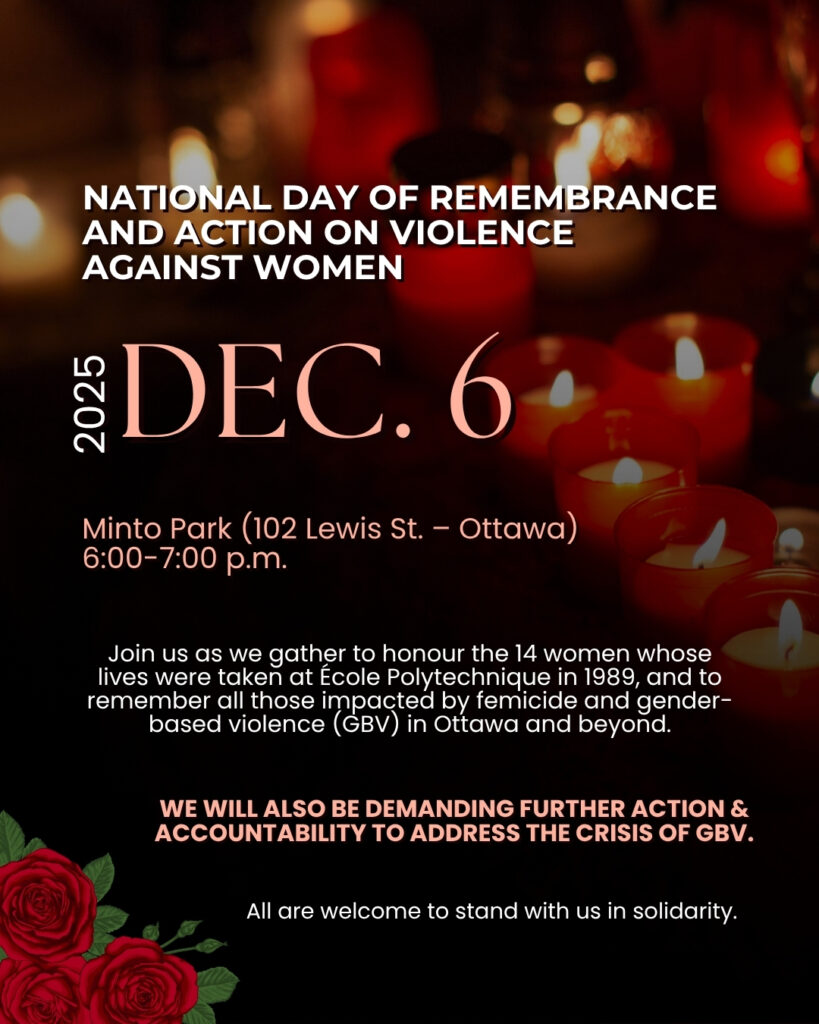
FOR IMMEDIATE RELEASE – After six femicides in Ottawa over the past year, community organizations to mourn victims and call for greater accountability at public vigil
This Saturday, Dec. 6, community organizations, allies, and survivors will gather for a vigil in Minto Park to mark the National Day of Remembrance and Action on Violence Against Women.
It has been 36 years since the targeted, misogynistic attack at Montréal’s École Polytechnique, where 14 women were murdered by a 25-year-old male perpetrator who expressed his hate for “feminists.” The massacre shocked the country.
And yet — despite the decades and the lessons learned through tragedy after tragedy, gender-based violence (GBV) continues in Canada at crisis levels. Across Ontario, more than 40 women were killed in acts of femicide in the past year alone, including six women in Ottawa. Their lives are irreplaceable.
On Saturday, we will gather to remember Jolene Arreak, Renée Descary, Rachelle (Francis) Desroches, Tracey Duncan, Brenda Rus, and Virginia Theoret. While being a space for grief, and to honour their lives, the Dec. 6 vigil is not solely about remembrance. While governments at all levels have taken important steps, we must continue to push for transformative commitment and action to halt the devastation of gender-based violence, up to and including femicide.
Gender-based violence shelters in Ottawa operate at or over capacity. Too often, survivors seeking help are met with waitlists, short-term fixes, or systems that fail to protect them. The safety of women and gender-diverse people is directly connected to adequate resources, survivor-informed systems changes, and greater accountability.
The ongoing crisis of Missing and Murdered Indigenous Women, Girls, and Two-Spirit people (MMIWG2S+) also exposes the deadly overlap between colonial violence, misogyny, racism, and state neglect. Indigenous communities remain under constant threat, and Dec. 6 must also stand as a call to address these intersecting epidemics of violence.
To match the seriousness of this crisis, we are urging all elected officials and governments — as well as community members, through support for these calls-to-action — to:
Adequately fund and sustain survivor-centred supports.
With thousands of women, gender-diverse people, and children being turned away from shelters every month, we must sufficiently invest in emergency supports, housing, culturally safe services, and long-term healing pathways for survivors, ensuring no one is left without access to safety and the chance to heal.
Meaningfully support non-carceral, community-led prevention strategies.
Grassroots, Indigenous, Black, racialized, newcomer, and 2SLGBTQIA+ led-organizations carry out essential frontline prevention, wellness, and intervention work. Their leadership must be supported, protected, and most importantly, funded equitably.
Establish independent accountability mechanisms to track progress and ensure lessons learned are effectively implemented.
Tragedies such as the 2015 triple femicide in Renfrew Country and 2020 mass shootings in Nova Scotia resulted in critical recommendations to combat GBV. Independent accountability bodies, such as a federal GBV commissioner and provincial Intimate Partner Violence commission, are necessary to ensure these recommendations are adopted and progress is monitored, across governments and over time.
Significantly increase MMIWG2S+ accountability and prevention.
Indigenous women are disproportionately more likely to be killed, sexually assaulted or subjected to intimate partner violence compared to non-Indigenous women. Governments must meaningfully commit to Indigenous-led safety frameworks and structural justice, including decisive action on the ongoing MMIWGS2S+ 231 calls for justice.
Making gender justice personal, not abstract.
With documented acts of femicide occurring in 29 Ontario communities in the last year alone – and intimate partner violence, a widespread form of GBV, being identified as endemic across our province – we urge every Ontarian to help honour victims and survivors, and transform our communities, through education, activism, solidarity, and everyday accountability focused on combatting gender-based violence.
Vigil Details:
From 6-7 p.m. in Minto Park (102 Lewis St), we will gather to hear from powerful speakers, remember lives lost to femicide, and share calls-to-action towards eliminating all forms of gender-based violence.
Speakers: Yvette Ashiri, women’s rights/gender equality advocate; Meseret Haileyesus, executive director of the Canadian Center for Women’s Empowerment; Yodit Girmay, executive director of the Mehari Centre.
A warming centre with hot beverages and emotional support will be available at Bethell Fieldhouse (166 Frank St) from 5-8 pm.
For more information/to arrange media interviews, contact:
Astara van der Jagt
Ottawa Coalition to End Violence Against Women
astara@octevaw-cocvff.ca