Cornerstone’s 8th Annual Purple Tie Gala Raises More Than $203,000
November 4, 2026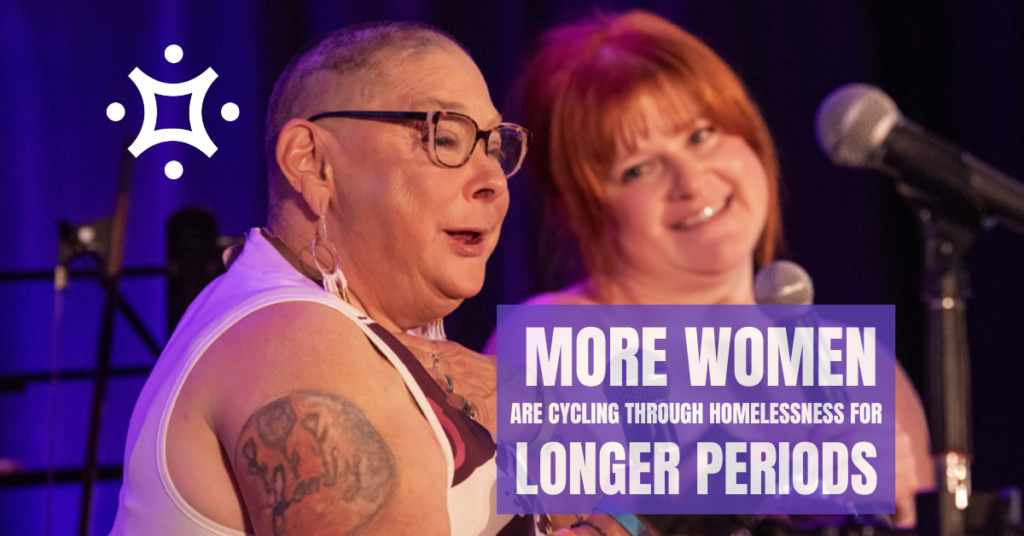
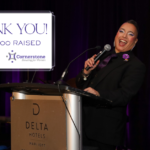
Elizabeth, a Cornerstone resident, shares her journey of discovering Cornerstone as a teenager and the support she has received over the years, alongside Anne-Marie Hopkins of Cornerstone Housing for Women, at the Purple Tie Gala on October 28, 2026, at the Delta Hotels Ottawa City Centre. Photo: Tia MacPherson-Abdulla/OBJ
Ottawa’s homelessness data tells a clear and urgent story: more women are losing access to safe, stable housing, and when they do, they are staying unhoused longer.
The number of single adult females experiencing homelessness almost doubled from 2020 to 2025: from 912 to 1,789. Over the same five years, their average length of stay in shelter increased from 71 days to 122 days. This tells us that more women are cycling through homelessness for longer periods of time.
The trend is even more concerning for senior women. In 2020, 60 senior females were identified in Ottawa’s homeless system, with an average stay of 114 days. By 2025, that had nearly doubled to 114 senior females, with the average stay still high at 104 days. Senior women are particularly vulnerable because many have low, single fixed incomes combined with ongoing health challenges, mobility issues, and at times, extensive histories with trauma.
Homelessness is not gender neutral. Women and gender diverse people often experience homelessness in ways that are less visible, more dangerous, more often shaped by violence.
Some of the senior women at our emergency shelter are experiencing homelessness for the first time in their lives. Many of them were caregivers and raised families, and are now living on a low income with little options for adequate housing. If you tie in chronic health conditions or mobility challenges, suitable housing becomes nearly impossible to find.
Supportive housing like ours at Cornerstone works because it addresses the whole person and all their needs. It creates stability by not just putting a roof over one’s head but looking at each individual and provides support tailored to their unique needs.
Our goal is to find a way to make housing work for each individual that we house. What can that look like? A woman may have a roof over her head but still need help managing diabetes, dementia, mental health symptoms, medication, income supports, or the ongoing effects of trauma.
How do we create stronger pathways to recovery, stability, and independence? When we provide a continuum of housing and support for women and gender-diverse people, we create the conditions for people to have safety.
The goal is to help women stay housed long-term, by addressing the whole person. For women, having healthcare supports built into housing can mean the difference between surviving and true stability. It also does other amazing things for our system such as drastically reducing repeated emergency room visits.
What needs to be done?
1- Build more affordable and supportive housing
2- Set a gender-equity target for new housing investments
3- Fund the full housing continuum, not just shelters or one type of housing. Investing in supportive housing is not simply a social service expense. It’s an investment in our community.
On National Housing Day, November 22, I am asking us all to see women and gender-diverse homelessness clearly. When we invest in safe, affordable housing for women, we build safety, stability, capacity for recovery, and strong communities.
By Anne Marie Hopkins,
Executive Director, Cornerstone Housing for Women

