House of Commons: Measures needed to strengthen women and gender-diverse shelters in Canada.
September 28, 2026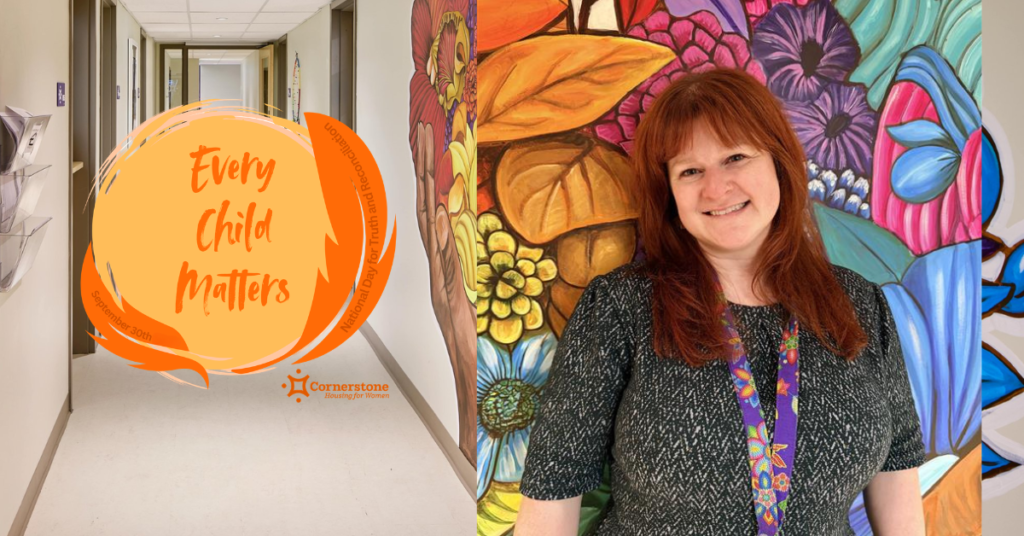
Truth and Reconciliation is not a checkpoint; it’s an ongoing commitment.
Truth and Reconciliation means keeping Indigenous women at the forefront of my mind when I’m making decisions at Cornerstone that impact the people who stay with us.
My journey with Truth and Reconciliation started in college and university. I learned a lot about the historical harm Indigenous Peoples have experienced through Residential schools and other forms of institutionalized racism and violence. It was a lot of Truth, maybe a little less Reconciliation. While I did learn a lot, it didn’t prepare me for working on the frontline. How could I make a difference on the frontline? What concrete actions and steps could I take to be a good ally and to minimize any further harm from working in these systems? And now, as an Executive Director, how do I make sure that we center Indigenous People in our decisions?
If you are working in this field, you realize that there is inherent racism built into the very systems we are working inside. Rules and guidelines in programs often create barriers for those who really need them. So, what can we do? When I started on this journey, I admittedly had to do a lot of personal work to dismantle some deeply embedded colonial beliefs and attitudes that I held. Some incredible people in my life had to ask me some really hard questions that I had to struggle with before I could really make any real movement into Truth and Reconciliation work. This work was outside of what any history textbook had taught me up to that point. I had to learn how to question systems and how to ask different questions.
- Learn from the experts. The incredible Indigenous women in our programs are truly the best teachers. We must purposely and intentionally listen to their needs and how they are experiencing our programs and services so we can continually improve them. We also do work in our programs alongside organizations like Minwaashin Lodge, which help guide us in our work and provide support to Indigenous People in our programs who need it. Other ways to learn from experts include subscribing to newsletters and reading reports released by important organizations that centre the voice of Indigenous women in our community - the Ontario Native Women’s Association and their report on Reconciliation with Indigenous Women can be found here.
- Embed cultural safety and ongoing learning into our organization. We commit to ongoing learning and unlearning for all staff on Indigenous-specific training that provides tangible understandings of how we can be better, minimize harm, and provide safety to the people we serve.
- Improving our data. This past year, Cornerstone has been on a journey to improve its data. The goal of this is to help us tell a better story of the incredible women and gender diverse people we walk alongside. We are working towards improving our Indigenous-specific data because it helps inform better programming decisions, communicate better to policymakers, and holds us accountable.
There are so many other ways for our organization to engage in Truth and Reconciliation; these are just a few.
Here are 3 books that shifted my thinking and helped me understand what it means to have a collectivist and community mindset, instead of an individualistic one.
- 52 ways to reconcile: How to walk with Indigenous Peoples on the Path to Healing by David Robertson
- Braiding Sweetgrass by Robin Wall Kimmerer
- The Break by Katherena Vermette
These are books that helped me change my mindset and gave me a different framework to view not only the work I am doing at Cornerstone, but how I see the world.
Anne Marie Hopkins